The American Tipping Habit Was Never About Rewarding Anyone — It Was About Paying Them Nothing

Photo: Yatchwicma Plusamisl, CC BY-SA 4.0, via Wikimedia Commons
The moment the check arrives at a restaurant table, most Americans already know what they're going to do. They'll calculate 18 to 20 percent, maybe bump it up if the service was especially good, and feel like they've done something decent. Tipping feels personal. It feels like a choice made between two people.
But tipping in America didn't emerge from generosity or social grace. It was engineered by industry lobbyists to shift the cost of labor onto customers — and the workers who depend on it today are largely the descendants of the same communities it was designed to exploit in the first place.
Where Tipping Actually Came From
Tipping existed in Europe before it arrived in the United States, primarily as a practice among aristocratic households who would slip coins to servants for extra attentiveness. When wealthy Americans began traveling to Europe in the late 19th century, they brought the custom home as a kind of status signal — proof that they'd seen the world and knew how sophisticated people behaved.
Not everyone was enthusiastic. A significant anti-tipping movement emerged in the early 1900s, with critics arguing that the practice was fundamentally un-American because it created a servant class dependent on the goodwill of strangers rather than a fair wage from an employer. Several states actually passed anti-tipping laws between 1909 and 1915. Washington, Mississippi, Iowa, and others made it illegal to offer or accept tips in certain contexts.
Those laws didn't last. The restaurant and railroad industries — which employed enormous numbers of Black workers in the post-Reconstruction South — lobbied aggressively against them. The argument was straightforward: if tips counted as wages, employers didn't have to pay much of a wage themselves.
The Railroad Connection Most People Don't Know
The most direct link between tipping and racial labor exploitation runs through the Pullman Company, which operated sleeping cars on American railroads starting in the 1860s. The company specifically hired formerly enslaved Black men as porters, paying them almost nothing and pointing to tips as their primary income source.
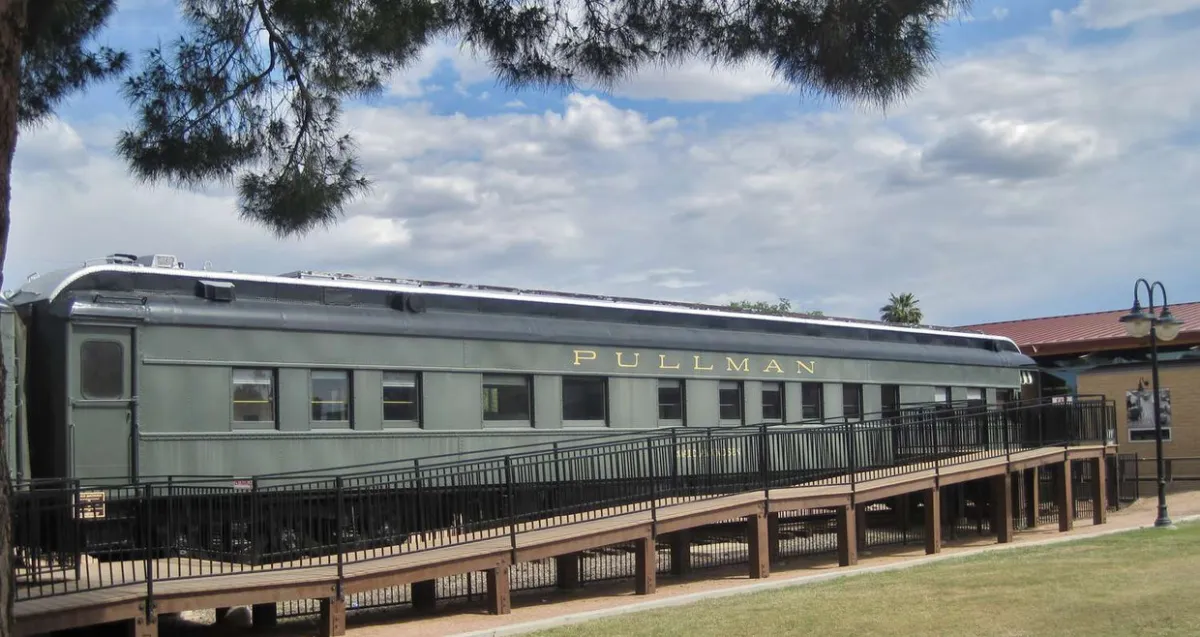 Photo: Pullman Company, via cdn11.bigcommerce.com
The Pullman porters became one of the most recognized Black professional classes in America — and also one of the most systematically underpaid. The company's entire business model depended on the assumption that customers would supplement wages the employer refused to provide. This arrangement was later formalized into law when Congress established a separate, lower minimum wage for tipped workers.
The Federal Tipped Minimum Wage Is Frozen in Time
Here's a number that tends to surprise people: the federal tipped minimum wage is $2.13 per hour. It has not changed since 1991. That's over 30 years without an adjustment, while the regular federal minimum wage — itself widely considered inadequate — has been raised multiple times.
The law assumes that tips will bring tipped workers up to at least the standard minimum wage, and employers are theoretically required to make up the difference if they don't. In practice, enforcement is inconsistent, tip pooling arrangements complicate the math, and workers in states without stronger protections often fall through the gap.
Seven states have eliminated the tipped minimum wage and require all workers to receive the same base pay before tips. In those states, servers still receive tips — often at similar rates — because tipping culture persists regardless of the underlying wage structure. This is one of the more important data points in the debate: tips don't disappear when workers earn a real base wage. They just stop being the only thing standing between a worker and poverty.
Why Restaurants and Not, Say, Plumbers?
One of the most revealing questions about American tipping culture is why it applies so selectively. Why do we tip restaurant servers and hotel housekeepers but not electricians, dental hygienists, or grocery store cashiers — all of whom provide services that require skill and direct customer interaction?
The answer is almost entirely historical accident combined with industry lobbying. The businesses that successfully argued for tipped worker carve-outs in labor law were the ones that ended up with tipping cultures. It was never about the nature of the work or the quality of service. It was about which industries had the political influence to pay their workers less.
This is also why tipping norms feel increasingly incoherent in 2024. The practice has crept into coffee shops, food trucks, and digital checkout screens in ways that have nothing to do with the original logic — however flawed that logic was. The tablet that rotates toward you at a bakery counter, showing tip options starting at 18%, isn't drawing on any tradition. It's just capitalizing on a habit Americans have been conditioned not to question.
What Other Countries Did Differently
The United States is genuinely unusual in its tipping culture. Most developed countries either never adopted widespread tipping or phased it out as labor laws strengthened. In Japan, tipping is considered rude — an implication that the worker needs charity. In much of Europe, a service charge is often included in the bill, and any additional tip is small and optional.
Countries that moved away from tipping generally did so by raising base wages and including service costs in menu prices. American restaurants that have tried this model — charging slightly more for food and paying servers a living wage — have had mixed results, largely because American diners are so conditioned to the tip-based system that higher menu prices feel like a penalty even when the total cost is similar.
The Takeaway
Tipping in America isn't a spontaneous expression of appreciation. It's a labor policy dressed up as a cultural norm — one that has its roots in post-Civil War exploitation and has been kept alive by industries that benefit from not paying their workers. That doesn't mean you should stop tipping servers who depend on it. It means the system itself deserves a lot more scrutiny than the question of whether 18% or 20% is the right number to leave.