It's Not the Screen Time That's Hurting Kids' Eyesight — Researchers Now Think It's Something Else Entirely
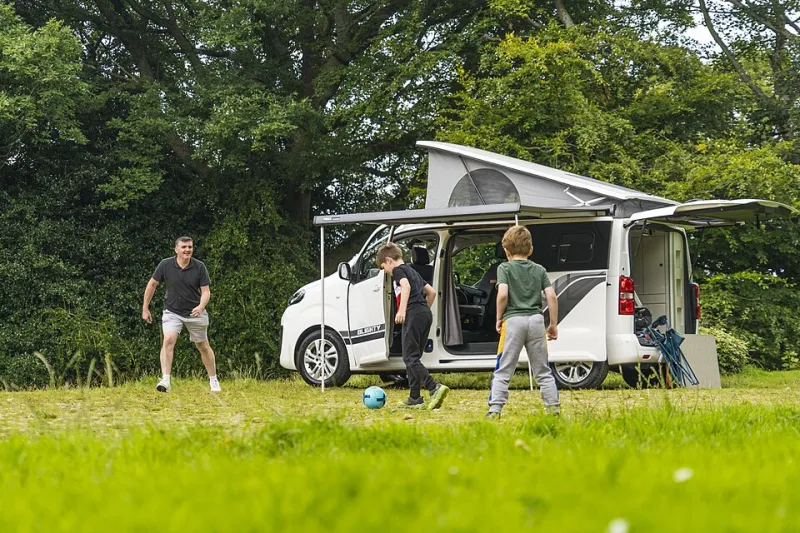
Photo: CruiseAmerica, CC BY-SA 4.0, via Wikimedia Commons
It's Not the Screen Time That's Hurting Kids' Eyesight — Researchers Now Think It's Something Else Entirely
If you grew up hearing "don't sit so close to the TV" or "stop reading in the dark, you'll ruin your eyes," you absorbed a piece of conventional wisdom that has been passed from parents to children for generations. The logic always felt intuitive: eyes are delicate instruments, close-range visual work strains them, and too much of it must cause lasting damage.
It's a reasonable theory. It's also largely wrong — and the actual explanation for why nearsightedness rates have climbed so sharply over the past several decades is both more surprising and more actionable.
The Myopia Surge Is Real
Before getting into causes, it's worth establishing that the trend itself is significant. Myopia — the clinical term for nearsightedness, where nearby objects are clear but distant ones are blurry — has become dramatically more common in younger generations.
Studies estimate that roughly half of the global population may be nearsighted by 2050, up from around 25 percent in the year 2000. In parts of East Asia, rates among young adults in urban areas have reached 80 to 90 percent. In the United States, the prevalence of myopia roughly doubled between the 1970s and the 2000s.
 Photo: East Asia, via www.vidiani.com
Something changed. The question is what.
The Screen Blame Game
The intuitive culprit, especially in recent years, has been screen time. Smartphones, tablets, laptops, and gaming systems have given children more reasons than ever to fix their gaze on something close and bright for extended periods. And because myopia rates have risen during the same era that screens proliferated, the correlation seemed to tell a story.
The problem is that correlation isn't the whole picture — and when researchers looked more carefully, the reading-and-screens explanation kept coming up short.
Studies comparing children with similar amounts of close-up work but different amounts of time spent outdoors found that outdoor time was a much stronger predictor of myopia development than screen or book time. Children in some East Asian countries read and study intensively — but they also spend far less time outside than children in comparable Western countries with lower myopia rates. Rural children, who often do similar amounts of near-work as urban children, tend to develop myopia less frequently.
The variable that kept mattering wasn't what kids were doing with their eyes up close. It was what they were doing outside.
What Natural Light Actually Does
Researchers now believe that exposure to bright natural light plays a direct role in healthy eye development during childhood — and that insufficient outdoor time may be a primary driver of the myopia epidemic.
The leading hypothesis involves dopamine. When the eye is exposed to bright light, the retina releases dopamine, a neurotransmitter that appears to regulate the growth of the eyeball itself. During normal development, the eye grows to a length that focuses light precisely on the retina. If that growth process overshoots — if the eyeball becomes slightly too long — light falls just short of the retina, and the result is nearsightedness.
Bright outdoor light appears to trigger dopamine release in a way that helps keep this growth process calibrated. Indoor light — even well-lit indoor environments — is typically many times dimmer than outdoor light on an overcast day, let alone direct sunlight. The eye may simply not receive the signal it needs to regulate its own development when children spend the majority of their waking hours inside.
Studies in Taiwan, Australia, and China have tested this directly. When schools added mandatory outdoor time — not physical education necessarily, just time spent outside in natural light — myopia rates among students slowed measurably compared to control groups. One Taiwanese program that added 80 minutes of outdoor time per school day showed significant results within a year.
Why the Old Explanation Stuck Around
The reading-causes-myopia idea has a surprisingly long history. Near-work strain was proposed as a cause of nearsightedness as far back as the 17th century, and the logic remained intuitive enough to survive for generations without strong evidence.
Part of the reason it persisted is that it contained a grain of truth in a different form. There is a real relationship between education levels, urban environments, and myopia — but researchers now believe that relationship is mediated largely by lifestyle factors, especially reduced time outdoors, rather than by reading itself. Educated, urban children tend to spend more time inside studying and less time outdoors. The culprit was the indoor environment, not the books.
The rise of screens gave the old theory a new villain, and the timing was plausible enough that the explanation spread without being rigorously tested. It also fit neatly into existing parental anxieties about technology — which made it easy to repeat and hard to question.
What Parents Can Actually Do
The shift in scientific understanding doesn't mean screen time has zero effect on children's eyes — staring at a close screen for hours without breaks does cause eye strain, though that's a temporary discomfort rather than a structural change to the eye. The 20-20-20 rule (every 20 minutes, look at something 20 feet away for 20 seconds) is still reasonable advice for reducing that strain.
But if the goal is reducing the risk of myopia development, the research points somewhere different:
- Get kids outside. Studies suggest that around two hours of outdoor time per day may be protective. The light doesn't have to be direct sunlight — even overcast outdoor light is significantly brighter than indoor environments.
- Outdoor time is not the same as physical activity. Simply being outside — reading, talking, sitting — appears to provide the light exposure that matters. Exercise outdoors is great, but the mechanism here is about light, not movement.
- Earlier intervention matters more. The years when the eye is still developing, roughly from early childhood through the early teenage years, appear to be the most critical window.
The Takeaway
The conversation around kids' eyesight has been focused on the wrong variable for a long time. Screens and books aren't innocent, but they're not the main story. The more important question — one that rarely comes up in pediatrician waiting rooms or school policies — is how much time children spend outside in natural light.
That's a harder behavioral change to make in a culture where school days are long, homework follows them home, and outdoor play has declined across the board. But it's the change that the evidence actually supports — and that's worth knowing.