The Two-Month Salary Rule for Engagement Rings Was Written by an Ad Copywriter, Not Handed Down Through History

Somewhere in America right now, someone is nervously doing math. They're calculating two months of their pre-tax salary, comparing it to the price of a ring, and wondering if they're spending enough to properly signal love and commitment to the person they want to marry.
That calculation — the formula, the anxiety, the whole framework — was written by an advertising copywriter. It was not inherited from centuries of romantic tradition. It did not emerge organically from cultural values around marriage. It was manufactured, deliberately, by one of the most successful marketing operations of the twentieth century.
The story of how a particular stone became the only socially acceptable engagement ring is, at its core, a story about how advertising can quietly rewrite what people believe is natural.
Before Diamonds Were "Forever"
Diamond engagement rings existed before De Beers got involved — but they were not standard, not expected, and not particularly common outside of wealthy families. The tradition of giving a ring at engagement goes back centuries in various forms, but the specific expectation of a diamond was not a broadly shared American custom heading into the 1930s.
 Photo: De Beers, via www.harbourcity.com.hk
De Beers, the South African mining conglomerate that controlled the overwhelming majority of the world's diamond supply, had a significant problem. The Great Depression had tanked diamond sales. The company was sitting on enormous stockpiles of stones and needed to rebuild demand — not just among the very wealthy, but across the American middle class.
In 1938, De Beers hired the Philadelphia advertising agency N.W. Ayer & Son to solve that problem. What the agency delivered was not just a campaign. It was a wholesale cultural repositioning of what a diamond meant.
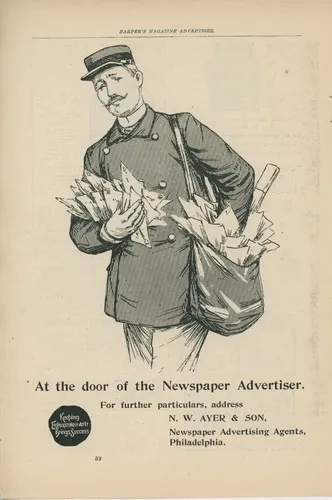 Photo: N.W. Ayer & Son, via i.ebayimg.com
The Campaign That Rewrote Romance
N.W. Ayer's strategy was sophisticated in ways that feel almost uncomfortably modern. Rather than running straightforward ads, the agency worked to embed diamonds into the cultural fabric — placing stones on celebrities and socialites, seeding mentions in newspaper columns, and connecting diamonds to romance in movies and media wherever possible.
The explicit goal, as documented in the agency's own internal memos, was to create a psychological association so strong that a diamond engagement ring would feel not like a purchase, but like an emotional necessity. They wanted to make the absence of a diamond feel like an absence of love.
In 1947, copywriter Frances Gerety wrote the line that would cement the entire project: "A Diamond Is Forever." It became one of the most recognized advertising slogans in history. It was also doing specific and clever work: it implied that a diamond, unlike other gifts, was not something you'd ever resell or trade away. This discouraged the formation of a robust secondhand market, which would have undermined De Beers's control over prices.
 Photo: Frances Gerety, via www.house-of-communication.com
By the 1950s, the share of American brides receiving diamond engagement rings had climbed dramatically. The campaign had worked. A preference had been engineered into existence and was now being passed down through families as though it had always been there.
Where the Two Months Rule Came From
If the diamond requirement was invented in 1938, the salary formula came even later — and its origins are even more nakedly commercial.
De Beers introduced the "one month's salary" guideline in the 1980s as a way to give buyers a spending benchmark. The idea was straightforward: people who don't know how much to spend will often spend less. Give them a number, frame it as a social norm, and the average transaction size goes up.
The guideline was later revised upward to two months in some markets, including a version of the campaign run in Japan — where De Beers had successfully exported the diamond engagement ring tradition from scratch in just a few decades, turning a country with no such custom into one of the world's largest diamond markets. That's not a footnote. That's proof of concept.
The two-months rule was never based on research into what made couples happy, what was financially responsible, or what constituted a meaningful gesture. It was a sales target dressed up as etiquette.
Why the Illusion Held
Several things made this particular piece of manufactured tradition unusually durable.
First, it got woven into a genuinely emotional moment. Engagements are high-stakes and high-feeling. People aren't in a skeptical frame of mind when they're buying a ring — they're in love, they're nervous, and they desperately want to do it right. That emotional state makes people especially susceptible to external cues about what "right" looks like.
Second, once enough people adopted the norm, social proof took over. When your parents had a diamond ring, and your friends are getting diamond rings, the behavior stops feeling like a marketing outcome and starts feeling like what people simply do. The advertising had done its job and could step back. Culture carried it forward.
Third, De Beers's artificial scarcity strategy kept diamond prices high enough that the rings felt significant. Diamonds are actually not rare — the supply was deliberately controlled to maintain the perception of scarcity. A stone that was genuinely abundant and cheap would not have carried the same symbolic weight, regardless of how good the ad campaign was.
What This Means for Tradition
None of this means that giving a diamond ring is wrong, or that couples who choose one are somehow fooled. People can know the history of something and still find genuine meaning in it. Traditions don't have to be ancient to be real.
But there's a difference between choosing something because it holds personal meaning and feeling obligated by a norm that turns out to have been engineered in a boardroom. The two-month salary rule, in particular, is worth examining with clear eyes — it was a sales target, not a measure of devotion.
The real tradition in American engagement culture, if there is one, is probably simpler than any of this: two people deciding to build a life together. The ring is just a ring.