A Diamond Ring Didn't Always Mean Forever — It Meant a Copywriter Had a Really Good Year

Photo: Mliz2000, CC BY 4.0, via Wikimedia Commons
The Tradition That Isn't
Ask most Americans where the diamond engagement ring tradition comes from and you'll get a vague gesture toward antiquity — something about ancient Rome, or medieval Europe, or the idea that the ring finger has a vein that runs directly to the heart. It feels old. It feels timeless. It feels like something people have always done.
None of that is really true. The diamond engagement ring as an American cultural institution — the specific expectation that a serious proposal requires a diamond, that the stone's size reflects the sincerity of the commitment, and that a man should spend roughly two months' salary to prove his love — was manufactured almost entirely by a single company over a remarkably short period of time.
The company was De Beers. The year was 1947. And what they pulled off is one of the most effective pieces of commercial persuasion in American history.
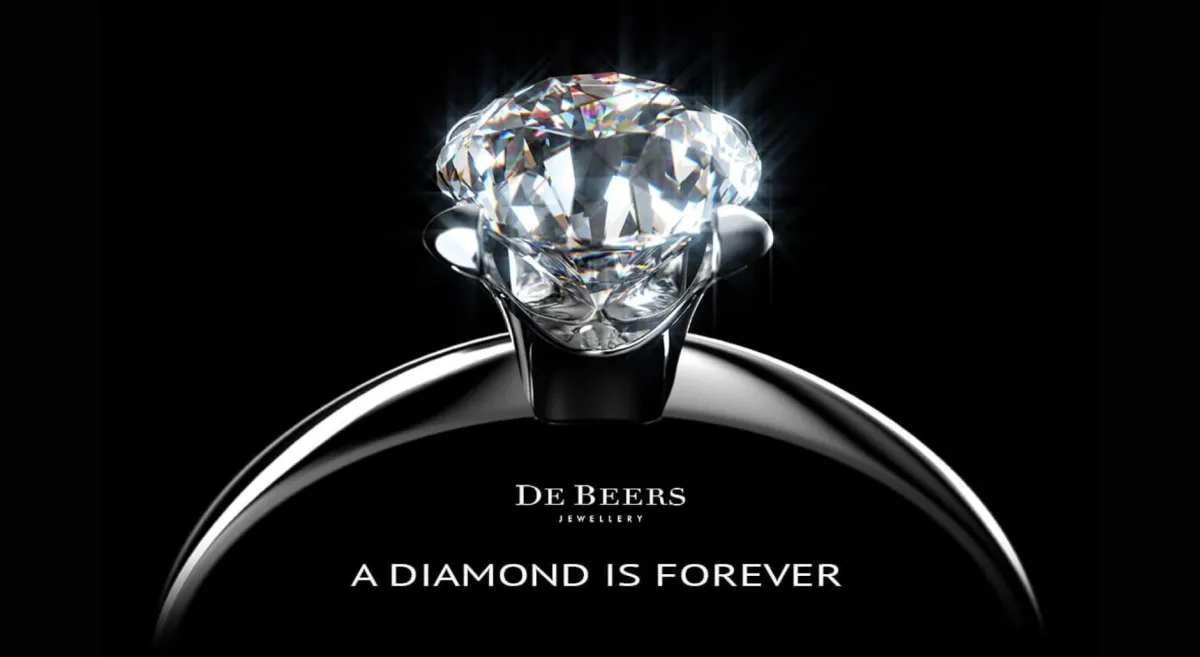 Photo: De Beers, via fashionchinaagency.com
Before the Campaign
To understand what De Beers achieved, it helps to know what diamond engagement rings looked like before their intervention.
Engagement rings existed, of course. Wealthy Europeans had exchanged them for centuries, sometimes featuring diamonds, sometimes featuring other gemstones. In America, rings were a common engagement gift, but they came in all varieties — sapphires, rubies, emeralds, and yes, sometimes diamonds, but without any particular expectation that diamonds were the correct or necessary choice.
Diamonds themselves were not especially rare. De Beers, the South African mining conglomerate, had spent decades consolidating control over the global diamond supply precisely because without artificial scarcity, the stones would have been worth considerably less than their reputation suggested. By the early twentieth century, De Beers controlled an estimated 90 percent of the world's rough diamond supply. They could set prices. What they couldn't yet do was manufacture demand.
That problem they handed to the advertising agency N.W. Ayer.
 Photo: N.W. Ayer, via digital.library.unt.edu
The Tagline That Built an Industry
In 1947, a copywriter named Frances Gerety was working on the De Beers account at N.W. Ayer. The campaign needed a line — something that would connect the diamond not just to romance but to permanence, to the very concept of enduring love. The line she wrote was four words:
 Photo: Frances Gerety, via cdn.gemporia.io
A diamond is forever.
It ran for the first time in 1948 and never stopped. Advertising Age would later name it the most recognized advertising slogan of the twentieth century. But the slogan was only part of the strategy. What De Beers and N.W. Ayer built around it was a coordinated cultural operation.
They placed diamonds in Hollywood films — not as product placements in the modern sense, but by lending stones to studios and making sure leading men were shown presenting them to leading women at pivotal romantic moments. They sent diamonds to celebrities and made sure the gifts were photographed and covered in the press. They approached fashion editors and society columnists, not to advertise, but to generate editorial coverage that positioned diamonds as the natural centerpiece of an engagement.
They also went directly into high schools. N.W. Ayer developed educational materials about diamonds that were distributed to home economics classes, framing the diamond ring as the appropriate culmination of courtship — not a luxury, but a standard.
The Two Months' Salary Rule Was Also an Ad
If the campaign's first phase was about making diamonds synonymous with engagement, its second phase was about establishing how much a diamond should cost.
The "two months' salary" guideline that still circulates today — sometimes inflated to three months in more recent marketing — was not a social norm that De Beers observed and reported. It was a benchmark they invented and then promoted until it became one.
The logic was elegant from a business standpoint. Tying the appropriate spend to a percentage of income meant the guideline scaled automatically with inflation and with the buyer's earnings. It also transformed the transaction into a moral one: spending less than the suggested amount implied insufficient commitment. The ring wasn't just jewelry. It was a test.
By the 1960s, diamond engagement rings had become the American default. By the 1980s, they were so embedded in the culture that most people genuinely believed the tradition stretched back generations. Some of their own grandparents had given diamond rings — because those grandparents had come of age during the original campaign.
What Diamonds Actually Are
Here's the geological reality that De Beers worked very hard to keep out of the conversation: diamonds are not rare. They are among the more common gemstones on earth. The appearance of scarcity was maintained through De Beers' control of the supply chain — they stockpiled diamonds, released them in controlled quantities, and for decades refused to allow a secondary resale market to develop, because a robust resale market would reveal that diamonds don't hold their value the way the advertising implied.
The famous "a diamond is forever" line served a dual commercial purpose. Yes, it was romantic. It was also a direct argument against resale: if a diamond represents eternal love, you don't sell it. You keep it. Which meant used diamonds stayed out of circulation, and De Beers continued to sell new ones.
The Feeling Was Real. The Tradition Wasn't.
None of this makes the emotion behind an engagement ring false. The love is real. The commitment is real. The desire to mark a significant moment with something lasting and meaningful is deeply human.
But the specific form that gesture takes — a diamond, sized to two months' income, presented as the only acceptable proof of serious intent — that part was drafted in a midtown Manhattan advertising office and rolled out to a country that had no idea it was being enrolled in a marketing campaign.
The next time someone describes a diamond ring as a timeless tradition, it's worth remembering that "timeless" in this case means approximately 75 years, and the tradition was launched the same year a copywriter needed a good tagline.
The feeling it represents is ancient. The obligation to buy a specific stone at a specific price point is considerably newer — and considerably more commercial — than it's ever been allowed to appear.