Your Scar Has Almost Nothing to Do With How Carefully You Cleaned the Cut

Photo: Judgefloro, CC0, via Wikimedia Commons
There's a ritual most Americans have performed since childhood. You scrape your knee, your elbow, maybe slice a finger on a can lid, and someone immediately reaches for the hydrogen peroxide, the antibiotic ointment, and a firm lecture about keeping it clean. The implication is always the same: take care of this wound properly, and it'll heal without a trace. Mess it up, and you'll carry a scar for life.
It's a reassuring idea. It puts us in control. The only problem is that it's mostly wrong.
The way your skin scars has far less to do with your first aid habits than with factors you were born with — and no amount of Neosporin changes that equation.
What Scar Tissue Actually Is
When your skin is damaged, your body doesn't simply rebuild what was there before. It launches an emergency repair process. Specialized cells called fibroblasts rush to the site and start laying down collagen — the structural protein that holds skin together. The problem is that this emergency collagen is laid down quickly and haphazardly, in dense, disorganized bundles rather than the neat, basket-weave pattern of normal skin.
The result is scar tissue: functional, but structurally different from the skin it replaced. It typically lacks hair follicles, sweat glands, and the pigmentation patterns of surrounding skin. It's the body prioritizing speed over aesthetics.
How dramatic that process becomes — how raised, how discolored, how wide — depends on a cascade of biological variables that your cleaning routine doesn't touch.
The Genetic Factor Nobody Talks About
If you've ever noticed that some people seem to heal with barely a mark while others develop thick, raised scars from minor injuries, you're observing real genetic variation. Researchers have identified multiple genes involved in regulating collagen production and the inflammatory response during wound healing. Variations in those genes mean some people's fibroblasts are simply more aggressive than others.
The most dramatic example is keloid scarring — a condition where scar tissue grows well beyond the boundaries of the original wound, sometimes for months or years after the injury. Keloids are significantly more common in people of African, Asian, and Hispanic descent, and they run strongly in families. Someone prone to keloids can develop one from something as minor as an ear piercing or a small vaccination site. No amount of careful cleaning would have prevented it. The biology was already in place.
Even among people without full keloid tendency, some individuals are simply prone to hypertrophic scars — raised, firm scars that stay within the wound boundary but remain visibly elevated. Again, genetics drives this far more than aftercare does.
Location Matters More Than Technique
Here's another variable that first aid rituals can't address: where on your body the wound happens to be.
Skin over joints — knees, elbows, shoulders — is under constant mechanical tension. Every time you bend or extend, you're pulling at healing tissue. That repeated stress disrupts the collagen-laying process and tends to produce wider, more noticeable scars. Wounds on the chest and upper back are notorious for scarring more prominently than those on the scalp or face, partly because of the direction of skin tension in those areas.
Dermatologists actually use something called Langer's lines — maps of the natural tension patterns in skin — to guide surgical incisions. Cuts made parallel to those lines tend to heal more cleanly than cuts made across them. A surgeon's placement of a single incision can matter more to the final scar than weeks of careful wound management.
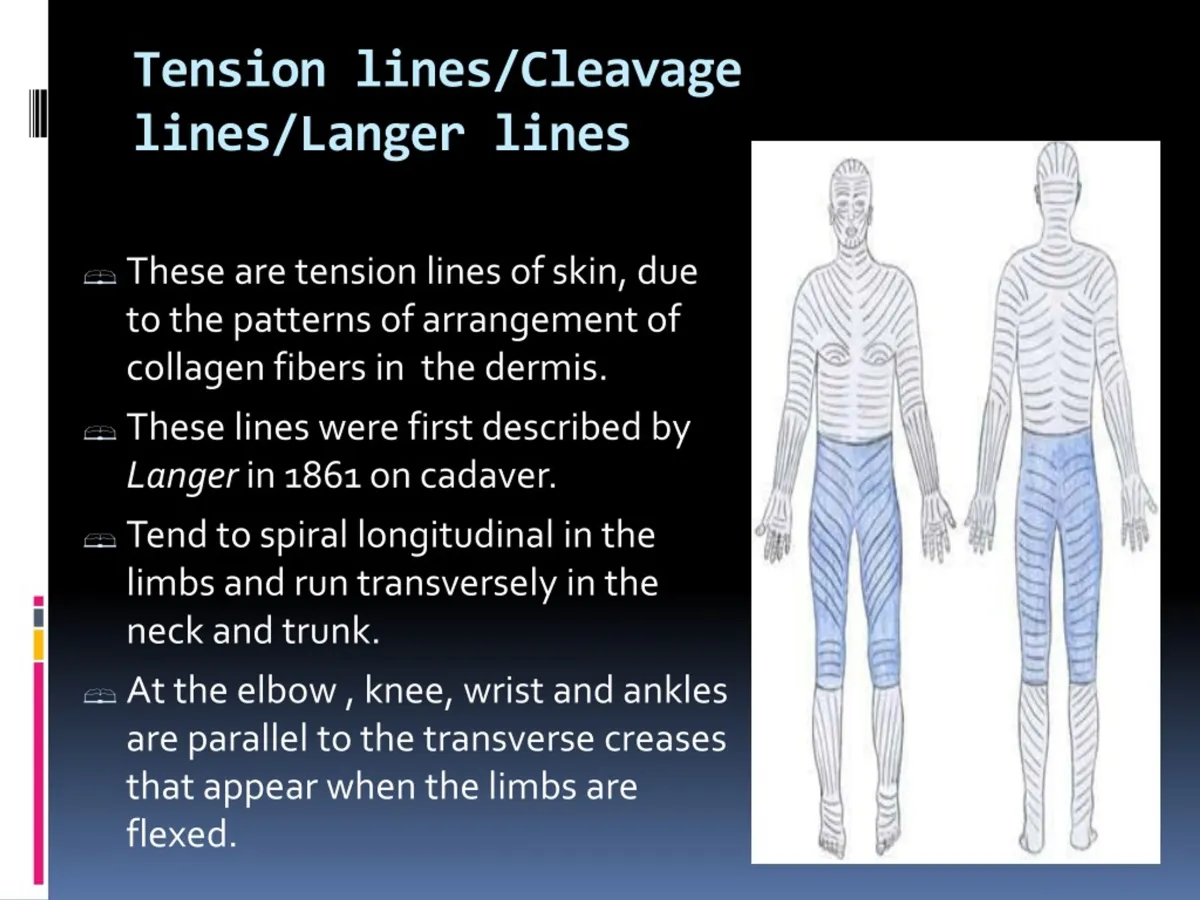 Photo: Langer's lines, via image4.slideserve.com
How Deep and How Long
Two other factors dwarf the importance of surface cleaning: wound depth and healing time.
Scars form when an injury reaches deep enough to damage the dermis — the layer beneath the outer epidermis. Purely superficial abrasions that stay in the epidermis typically heal without permanent marks. Once you're into the dermis, scar formation becomes likely regardless of what you put on top.
Healing time matters too. Research has consistently shown that wounds kept moist and protected — not dried out — close faster, and faster closure generally means less scarring. This is where the moist wound healing approach actually does have scientific backing. But "moist healing" means keeping a wound covered and using a simple petroleum-based barrier like plain Vaseline. Multiple studies, including work published in the Journal of the American Academy of Dermatology, have found that plain petrolatum performs as well as or better than antibiotic ointments like Neosporin for typical wound healing — and without the risk of developing a contact allergy to the active ingredients.
So Where Did the Neosporin Gospel Come From?
Antibiotic ointments became household staples largely through pharmaceutical marketing in the mid-20th century, amplified by a cultural moment when antibiotics felt like magic. The logic made intuitive sense: infection delays healing, delayed healing means more scarring, therefore prevent infection and prevent scars. The chain of reasoning isn't entirely wrong — infected wounds do tend to scar worse. But the leap to "antibiotic ointment prevents scarring" was never supported by strong evidence for typical, clean minor wounds.
Parents passed the advice to children, pediatricians repeated it as general guidance, and the Neosporin association burrowed into American medicine cabinets as received wisdom. The product itself is fine for what it does. The mythology around what it prevents is what got inflated.
The Takeaway
If you've spent years quietly blaming yourself for a visible scar — convinced you didn't clean it well enough, applied the ointment too late, or somehow failed the wound — you can let that go. Your skin's healing response is a deeply personal biological process shaped by genetics, skin tone, wound location, and depth. First aid matters for preventing infection, and keeping a wound moist and covered genuinely helps. But the scar you end up with was largely determined by factors set long before the injury happened.
That's not a reason to be careless with wounds. It's just a reason to stop treating every scar like a personal hygiene report card.